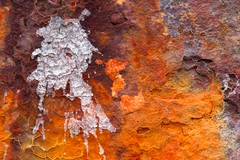
OK, the first order of business is to give credit where credit is due. This photo is titled "Silver Soldier" and was made by the outstanding professional photographer, Tony Sweet. I encourage you to jump over to Flickr and
view some more of his amazing photos. You can also view his work at
his personal website.
Now, let's examine this photo for a clear life lesson we all need to remember -- variations around us often serve as essential ingredients in the creation of beauty. Variations create harmony, often.
Notice, also, the various color elements in "Silver Soldier" and how they don't fight each other. Rather, they come together, with their own characteristics, and contribute those various characteristics to result in a visual masterpiece.
Another life lesson: Where does one color stop and another color start? You can't really tell. Instead, there's a "blending" of colors. And, although some two or three colors may appear to be the same, upon closer examination, we discover that they really are different.
Where do you see yellow? Yes, it appears in several places.
Where do you see gold? Yes, in several places.
Where do you see brown? That's right -- in several places.
And what about silver? Yep, again, it's in several places, even though our eye is drawn to the silver as though it were one discrete element. Yet, as we examine closer, we discover that some of the lines around the silver are not clearly and distinctly defined. The silver contributes its beauty to the whole by blending in -- and at the most appropriate location.
Now, for the "transfer of learning" part to teach us what we need for beautiful planning within our group/team....
The composition of your technology planning team is crucial. This is definitely not a one-person job! And, not everyone on the team has to view things in the identical fashion. Variety of opinion, talent, experience, work ethic, endeavor, and zeal has the potential for making a planning team strong and resilient when some of the problems buffet us. And, those problems will definitely come!
Just imagine that your committee is made up of both seasoned teachers, as well as the novice. They have different perspectives on many things, yet each of them has valuable input for the whole committee.
You will need not only teachers, but also administrators, civic leaders, parents, students, professionals (doctors, lawyers, insurance executives), retired individuals, .... well, you get the point. You need a veritable cornucopia of people with a broad range of talents, experiences, and opinions. However, your role as a committee leader is critical.
You have to know how to take the best parts of each person's contribution and meld that into a meaningful whole.
That's precisely what Tony did for us in this photograph. First, he had to stop and take notice of this beautiful image. Then, he had to use his best skills in photography to know the proper exposure, shutter speed, and position in order to yield the best image. The result is that we have a thing of beauty to admire. Other passersby might have thought that was just an ugly rust spot, but Tony incorporated the strength of his talent and composed the photo that magnetizes our appreciation. All those elements that contributed to making this photo a lesson for us were brought together at the right time, in the right proportions, from the right angle. Such a great lesson for leadership!
None of this information is news to us. Yet, we have to be reminded of this frequently. Amidst the hustle and bustle of our daily lives, trying to coordinate the work of our planning committee, even as we go about managing the technological uses being applied in our schools or organizations, we often allow the beauty around us to get lost in the seemingly overwhelming "jobs" that consume our time.
Hence, I encourage you to look carefully and closely at the beautiful photograph that Tony Sweet has given us...and ponder the beauty lying around you in the form of people's talents, opinions, etc.
Isn't it really a thing of beauty that we have the combination of people working in harmony with us. (Remember, too, that "harmony" is not the same as "unison." Harmony in music comes from various tones, but combined in proper proportions. The same is true among people.)
Now, it's your turn.
What do you think about this?
What has "the beauty of variations" meant to your work?
How can you use this photographic image to help your work with your technology planning and implementation efforts?
Please contribute your thoughts. They will help make this blog more beautiful, too!